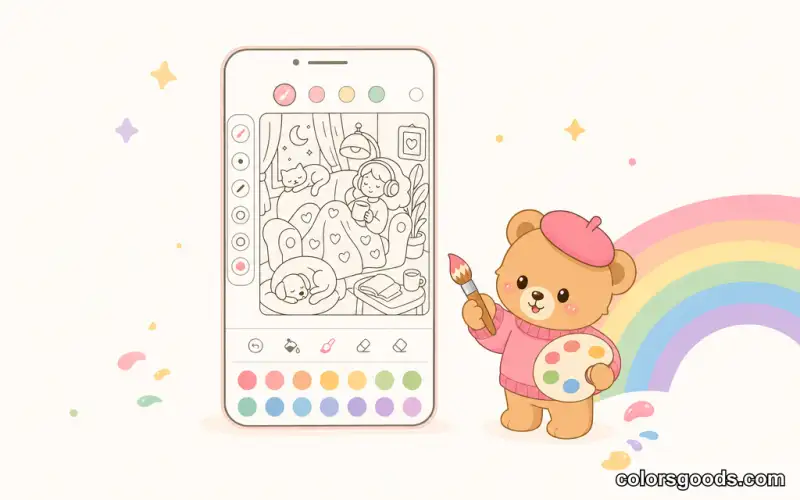
Coloring pages for the classroom: printing, reusing and keeping kids on task
Coloring pages work in a classroom when three things are true: the page matches the students' fine motor level, the activity has a clear ending, and the teacher is not spending the session at the printer. Free pages that you open in a browser and print at 100% scale on A4 or Letter handle the first two — and a few printing habits handle the third. Everything on this page is free, with no account and no ads, so nothing needs approving by an administrator.
This guide covers what to print, how to keep a class set going for a whole term, which designs suit which age, and the five classroom moments where coloring genuinely pays off.
Key Facts
- Free pages with no account and no ads — no sign-up wall to explain, no ad content to police mid-session.
- Prints at 100% scale on A4 and US Letter — the two formats schools actually use; lines stay sharp instead of fuzzy.
- 198 hand-drawn scenes across 7 collections — from simple large-area drawings for ages 4+ to detailed pages for older students.
- Works on any classroom device — no install, so it runs on shared tablets without touching the device image.
The five moments when coloring earns its place in a lesson
Coloring is not a filler — it is a tool with a specific job. Used in the right moment, it does something no worksheet does: it occupies the hands while the mouth closes.
1. Early finishers (the big one). A finished worksheet leaves a child with nothing to do while others are still working. A single coloring page in a "finished" folder solves this permanently. Keep four or five printed pages in a labelled folder on the shelf — a child takes one, colours quietly at their desk, and the room stays calm.
2. Transitions. Two minutes before lining up, after lunch, before dismissal. Short, structured and quiet beats a loud countdown. Say "one page each, and we stop when the timer goes" — the ending is the whole point.
3. Indoor recess and wet-weather breaks. Sports fields flooded, extreme heat, a class of 30 with pent-up energy. Put on calm music, hand out pages by interest rather than by row, and let the energy come down gradually.
4. Substitute and emergency cover. The single most valuable thing a teacher can leave for a supply teacher is an activity that needs no explanation and no preparation. Pre-printed pages in a labelled folder plus a note ("pick one, colour it, leave it on the desk") work without you being there.
5. Brain breaks and focus resets. Five minutes of structured, repetitive activity between two demanding tasks resets attention better than five minutes of free play. For students who find sitting still hard, structured coloring is often the break that actually works — our guide to coloring pages for kids with ADHD goes into the practical details.
What to print, and how not to waste paper
Printing is where classroom coloring dies: 30 shrunken copies with faint lines, or 30 copies of a page nobody wants. Four habits fix both:
- Print one test copy first. Check the size is right, the scale is 100% (not "fit to page"), and the quality setting is Normal or Best rather than Draft. One test page prevents a wasted class set and tells you whether the design has enough line weight to survive a year 3 pencil.
- Print black and white for line art. Coloring pages are black lines on white paper; there is no colour ink involved. This is not a quality compromise — it is the correct setting.
- Match the page to the age. A detailed adult page handed to a year 1 student is a behaviour incident waiting to happen. Use the age table below and choose two difficulty levels per session, not one.
- Print the pages students choose where possible. A library browsed on a screen for 60 seconds before printing beats a stack of random pages. If you have a classroom screen, let each group pick a theme for the week — animals one week, landmarks the next.
Which pages suit which age
Age matters more than theme. The table below is the practical version, based on fine motor development and attention span rather than curriculum documents:
| Age | What works | Page type | Realistic session | |---|---|---|---| | 4–5 | Simple, separate shapes, thick lines, no fine detail | Large-area animals, simple scenes | 5–10 minutes | | 6–7 | Recognisable subjects, closed zones, one clear focal point | Cute characters, simple buildings, holidays | 10–15 minutes | | 8–10 | More detail, patterns starting to appear, nameable subjects | Landmarks, scenes, characters with props | 15–25 minutes | | 11–13 | Fine detail, symmetrical patterns, "satisfying" complexity | Mandalas, intricate scenes, famous places | 20–40 minutes |
Two useful starting points: Boo Goods for simple large-area drawings that younger students can actually finish, and Popular Places for landmarks that pair with geography topics. For seasonal themes, Cute Christmas and Tiny Bible cover religious-education and holiday needs. If a page needs to double as a geography or RE resource, the complete collections guide explains what each collection contains.
Reuse, storage and keeping the folder alive
A class set is an investment in paper; treat it like any reusable resource.
- Laminate three or four favourites per class. A laminated page with a dry-erase marker lasts months and turns into a calm-down station rather than a one-off activity. Do not laminate anything students will want to keep.
- Use one labelled folder per activity type — "Early finishers", "Indoor recess", "Cover". Anything that requires thinking at 3 pm on a Friday will not happen; a labelled folder makes it automatic.
- Refresh the folder each term. Six pages per folder, swapped at the start of each term, costs almost nothing and keeps the activity feeling new.
- Print on 120 gsm if you can. Standard 80 gsm printer paper wrinkles and tears under a determined pencil; 120 gsm survives a class of 30. If your school only has 80 gsm, print single-sided and accept that some pages will not be keepers.
- Screen version for shared tablets. If devices are available, the same pages work in the browser with no install, which is useful for rotation stations — our notes on screen time and coloring for kids cover how to set boundaries around it.
FAQ
Are these classroom coloring pages really free?
Yes. Every page is free to use and print for classroom purposes, with no account, no sign-up, and no ads. There is no premium tier and nothing that requires a school budget or administrator approval.
How many copies should I print for a class?
Print what one activity needs, not a term's supply. For early finishers, four to six different pages cover most weeks; for a whole-class indoor recess session, print one per student plus three spares, and always test one copy first to check the print scale.
What paper should I use for classroom coloring pages?
Standard 80 gsm printer paper is fine for single-use pages; 120 gsm is better if pages will be reused or if students press hard. Print single-sided so marker or paint bleed does not ruin a second page.
Which coloring pages work for students with ADHD or autism?
Simple designs with closed, generous zones and no fine detail — and a clear time limit. Structured formats like color by number or the ADHD-focused pages in our coloring pages for kids with ADHD guide tend to hold attention longer than open-ended pages.
Can I print these in black and white?
Yes, and you should — coloring pages are black line art on white paper, so a black-and-white print is the correct, economical setting. Avoid "draft" or "ink-saving" quality modes, which thin the lines and make small areas hard to see.
Do I need an account to use these with my class?
No. There is no sign-up, no login, and no account to manage for a class set. Progress saves on the individual device for screen sessions, which means nothing to monitor and nothing to delete at the end of the year.
Set up the folder this week
Pick two pages per difficulty level, print them at 100% scale, and put them in a labelled folder. That is the entire setup — and it is the difference between a calm ten minutes and a chaotic one.
Open the free coloring pages on ColorsGoods — no account, no ads. For more, see coloring pages for kids, the family coloring activities guide, or how to choose the right coloring pages.
Learn more about the project →
Colors Goods is researched, written, and reviewed by our small editorial team so every post stays clear, practical, and family-friendly.
Reviewed by Ana Ribeiro
Editorial contributor — coloring activities and creative learning