
Coloring at work: a practical guide to stress relief for professionals
Professionals from every field are discovering that a short coloring session works as a genuine mental reset. Unlike scrolling through a phone — which keeps the same neural pathways active — coloring engages the brain differently: hand, eye and color selection come together in a low-pressure task that has no deadline and no wrong answer.
This guide explains how nurses, teachers, therapists, remote workers and students use coloring to manage the specific stresses of their day, and how to build a five-to-ten-minute practice that fits any schedule. If you are new to digital coloring, the digital coloring complete guide covers the fundamentals first.
Why coloring works as a workplace reset
Traditional breaks — social media, news, quick snacks — rarely reset the brain. They keep it in the same information-processing mode as work. Coloring does something different: it activates motor control through hand movement, visual processing through color choice, and sustained attention through filling shapes. The result is a genuine cognitive shift.
Research supports this. A 2024 study in Frontiers in Psychology found that 20 minutes of coloring lowered cortisol — the primary stress hormone — more effectively than unstructured relaxation. Another line of research, from the University of the West of England, linked coloring with improved performance on tasks requiring sustained attention. The same skills professionals depend on all day.
That is why more companies now stock coloring materials in wellness programs and why schools keep pages in staff rooms. It is a low-effort, high-impact tool that works at a desk, in a break room, or in a parked car between shifts. Our guide on the science of coloring for stress relief explores the evidence in more depth.
How each profession can use coloring
Nurses and healthcare workers
Nurses face long shifts, emotional labor and high-stakes decisions with very little recovery time. Compassion fatigue — the emotional exhaustion that comes from caring for people in pain — is a real risk.
A ten-minute coloring session between patients offers a structured way to disengage without suppressing emotion. The repetitive motion of filling shapes activates the default mode network, the brain region linked to daydreaming and emotional processing, which gives the mind room to process difficult experiences.
The practical advantage is huge: no supplies to store, no cleanup, no space to clear. A phone app opens in seconds. A pilot program in several Dutch hospitals that added coloring kits to staff wellness saw a 23% reduction in self-reported burnout symptoms among nurses who colored regularly during breaks.
Teachers and educators
Teaching demands constant cognitive switching — lesson planning, classroom management, grading, parent communication. Teachers also absorb their students' emotional energy, which adds another layer of fatigue.
A five-minute coloring break before a parent-teacher conference helps shift from classroom mode to a composed, present state. After a difficult period, coloring provides a physical anchor: something concrete and finite to focus on while the nervous system resets.
Teachers who color also model something important. When a teacher says "I need five minutes to reset" and the reset involves a page instead of a phone screen, it normalizes healthy coping for the whole classroom. The family coloring activities guide offers age-appropriate ideas for bringing that practice into group settings.
Therapists and counselors
Therapists hold space for other people's pain all day. The emotional labor is enormous and burnout rates in the profession are consistently high.
For therapists, coloring works on two levels. Personally, it creates a boundary practice: finishing a session, coloring for eight minutes, and starting the next session with a clearer mind. Clinically, understanding the coloring experience firsthand makes it easier to guide clients through it as a regulation tool.
The physical act of choosing colors, focusing on shapes and completing a page creates a natural reset point that journaling or deep breathing alone sometimes cannot achieve.
Remote workers and home office
Remote work blurs the line between work and life. There are no commute boundaries, no hallway conversations — just screen time that stretches until late evening.
The problem is not finding time for breaks; it is taking them without guilt. Coloring solves both sides. It is clearly a break (you are not working) and clearly productive (you are restoring focus and preventing burnout). This removes the mental negotiation that usually stops remote workers from stepping away.
A colored page also works as a visual signal. When you pick up your tablet and open a coloring app, your brain registers that the next ten minutes are not for email. That small ritual creates the structure a home office lacks.
Students and young professionals
Students face exam pressure, heavy workloads and the mental fatigue of sustained learning. Graduate students and early-career professionals often carry student-level stress with professional-level expectations.
Coloring gives them a structured study break that actually improves what comes next. The shift from analytical thinking to relaxed visual processing allows the brain to consolidate information — the same mechanism that makes rest improve memory, but on a shorter timescale.
Portability matters here. A phone and a coloring app need no desk space, no setup and no cleanup. You can color between lectures or in a library without disturbing anyone.
How to start coloring at work
The biggest barrier is rarely time. It is self-consciousness. Most professionals worry that coloring looks unprofessional. Here is how to handle it.
Keep it digital. A coloring app on your phone looks like any other app. You can color during a break without anyone knowing or caring.
Keep sessions short. Five to ten minutes is enough for a cognitive reset. A single partially-completed page still delivers the benefit. The goal is the mental shift, not the finished product.
Use natural transition points. Color between meetings, before or after a difficult task, during lunch, or at the end of a shift. Those are the moments the brain most needs a reset.
Frame it as a wellness practice. If anyone asks, "I use this to reset between tasks" is a complete and professional answer. You do not need to justify it more than a walk around the building.
Start with tap-to-fill. This mode lets you select a color, tap a region, and watch it fill. No drawing skill required. You get a satisfying result in under five minutes. For technique ideas beyond the basics, see coloring techniques for beginners.
What to look for in a tool
The ideal tool for workplace coloring meets three criteria: it works on your phone, it loads quickly, and it does not require an account to start.
- Mobile-first design. Your phone is always with you. Look for responsive interfaces and pinch-to-zoom for detailed areas.
- Quick page access. You should find a page in under 30 seconds, organized by theme, difficulty or mood.
- Offline capability. Workplace Wi-Fi is not always reliable. A tool that works offline means you can color regardless of the network.
- No forced sign-up. An account requirement adds friction that defeats the purpose of a quick break.
- Curated palettes. Pre-made palettes save time and produce good results even without color theory knowledge. Custom palettes are a bonus for those who want control.
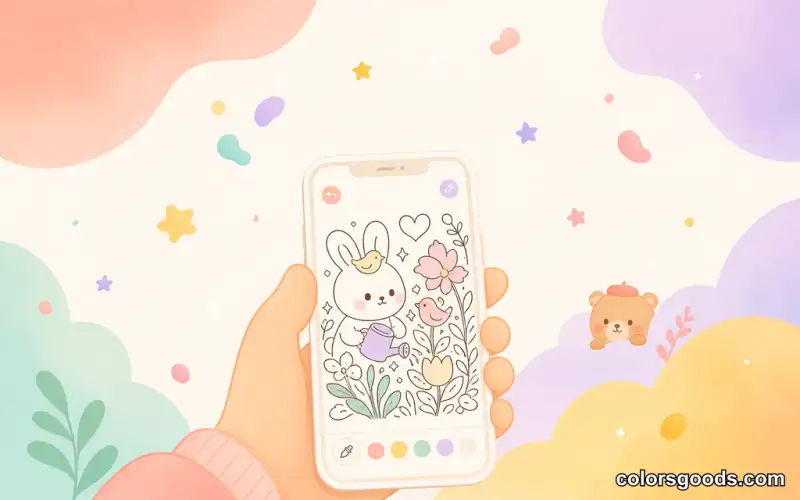
ColorsGoods was built for exactly this use case. It is browser-based, works on any device, loads instantly and requires no sign-up. Pages are organized by mood and theme, and tap-to-fill mode produces a satisfying result in minutes.
Building a sustainable habit
Habits fail when they require decisions. Remove the decisions and the practice sticks.
Attach it to an existing habit. Color while coffee brews, during the first five minutes of lunch, or right after closing your laptop. The existing habit becomes the trigger.
Set a timer. Ten minutes, then stop. The timer removes the "how long should I color?" negotiation.
Keep a favorites list. Decision fatigue kills habits. Save a few pages you love and go straight to them.
Track your sessions. A checkmark on a calendar creates gentle accountability. After a month, the pattern becomes visible — and motivating.

FAQ
Is coloring at work actually professional?
Yes. Coloring is a cognitive reset technique, not a toy. Nobody questions a colleague who takes a walk to clear their head or practices deep breathing. Coloring serves the same function — the key is doing it during a break, not during a meeting.
How long should a professional coloring session last?
Five to ten minutes is enough for most people. Research on cognitive restoration shows benefits after as little as five minutes of focused visual engagement. Longer sessions are fine, but fifteen minutes is usually the practical ceiling for a workday tool.
Do I need artistic skill to benefit?
No. The stress-relieving effects of coloring are independent of artistic ability. Tap-to-fill mode produces good results at any skill level. The benefit comes from focused attention and repetitive motion, not from the artistic outcome.
Can coloring replace therapy or medication for stress?
No. Coloring is a complementary tool, not a treatment. If you are experiencing clinical anxiety, depression or burnout, coloring can support your recovery alongside professional treatment — but it should never replace therapy, medication or other clinical care.
Ready to reset your workday?
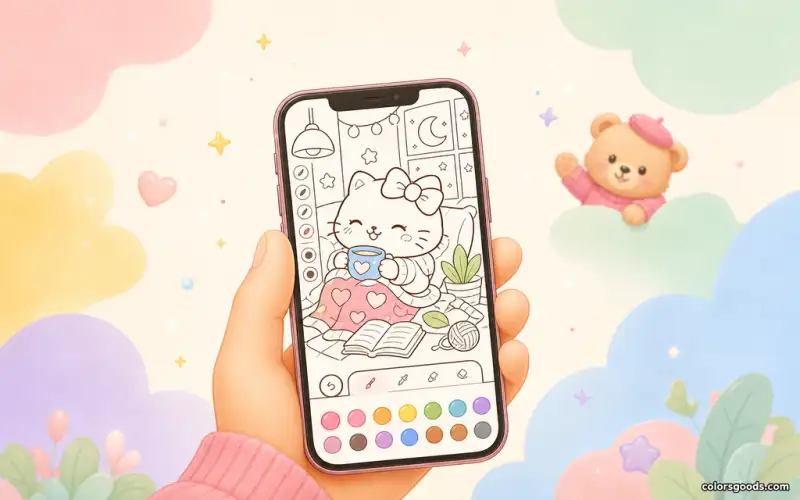
ColorsGoods is free, works in any browser and requires no account — you can be coloring within seconds of opening a page. Whether you are a nurse between shifts, a teacher after a difficult class, or a student between study blocks, a short coloring session can be the most effective break you take today.
For a broader view of how coloring fits into daily life, read the coloring lifestyle integration guide. And if you want to go deeper on the mental health side, the art therapy complete guide explores how creative activities support emotional wellbeing.
Open ColorsGoods and start your first workday reset — it takes less time than making coffee, and the reset lasts longer.
Learn more about the project →
Colors Goods is researched, written, and reviewed by our small editorial team so every post stays clear, practical, and family-friendly.
Reviewed by Maya Chen
Editorial contributor — mindfulness and relaxation coloring