Coloring for wellness: focus, recovery, and calm at every stage of life
Coloring for wellness is about more than relaxation — it is about using a simple, accessible creative activity to support wellbeing across every stage of life. The same practice that helps a stressed adult reset their nervous system can help a student with ADHD build focus, someone recovering from burnout rebuild capacity for rest, and an older adult find a familiar, comforting rhythm in daily life. There is no skill threshold, no performance pressure, and no expensive equipment — a page and a few colors, or a phone, are enough to begin. This guide explores how coloring supports focus, recovery, and later-life wellbeing, with honest limits and practical routines.
For the wider science behind these ideas, start with our coloring for mental health complete guide.
How coloring supports focus and attention
Coloring is one of the few activities that engages attention without demanding it. That unusual quality makes it valuable for people whose brains are wired for novelty and stimulation — particularly those with ADHD.
- Immediate visual reward. Every section you fill produces a visible result — the fast feedback loop an ADHD brain craves.
- Structure with freedom. A page provides boundaries and guidance, but you still make the creative decisions. This balance works well for minds that resist rigid constraints but thrive with gentle direction.
- Natural hyperfocus. Many people with ADHD experience intense concentration on engaging tasks. Coloring — especially moderately detailed pages — can invite that state without the frustration of forced attention.
- Sensory grounding. The physical act of coloring provides tactile input that helps regulate the nervous system, channeling restlessness into a focused activity.
Research on structured creative activities shows they can reduce restlessness and support attention for short, focused periods. A practical focus session: choose a page with moderate complexity, pick a limited palette of five to ten colors in advance, set a timer for fifteen to twenty minutes, and start with the largest sections to build momentum.

Coloring for burnout recovery
Burnout is a state of physical, emotional, and mental exhaustion caused by prolonged stress. The World Health Organization recognizes it as an occupational phenomenon characterized by energy depletion, increased mental distance from work, and reduced professional efficacy. Recovery requires deliberate restoration — and the last thing a burned-out person needs is another demanding activity.
Coloring works for burnout precisely because it asks almost nothing:
- Low cognitive load. Big shapes, clear outlines, minimal detail. When executive function is depleted, simple pages feel like relief instead of another demand.
- No pressure to finish. You do not need to complete a page in one session, or ever. Half-finished pages are fine.
- A clear boundary. Coloring creates a visible break between work-mode thinking and rest, and resists the productivity mindset that fuels burnout guilt.
- Small wins. Even five minutes of coloring produces visible progress, restoring a small sense of accomplishment.
Build the habit gently: start with five minutes at the same time each day, use three to five colors to avoid decision fatigue, and pair the session with something pleasant — music, a warm drink, a comfortable chair. For the science behind the stress response, see our coloring for stress relief guide.
Coloring for seniors
Coloring can be a genuinely joyful activity for older adults, especially when pages are designed with their needs in mind. The most comfortable pages share three qualities: clear, bold outlines; larger color areas that do not demand fine precision; and low visual noise — simple backgrounds and clean layouts that keep the page readable and calm.
Familiar themes matter too. Flowers, birds, seasonal scenes, cozy interiors, and everyday objects feel engaging without being overwhelming. Because many older adults colored as children, the activity often carries warm memories and a sense of competence — and it is a natural shared activity: a grandparent and grandchild can color side by side with no pressure on either of them.

For families, this makes coloring a simple screen-light alternative to digital entertainment: an afternoon break, a calm evening ritual, or a quiet shared moment. Our cozy coloring pages collection includes many gentle, accessible designs suited to this.
Coloring and dementia care
For people living with dementia, coloring can be a meaningful activity that supports wellbeing in several important ways. It is not a treatment — nothing in this guide should be read that way — but it can improve quality of daily life. A page with a few colors, or a tap-to-fill phone, is enough to begin.
- Cognitive stimulation without frustration. Selecting a color and applying it to a region activates attention, visual tracking, and motor planning. The structure is gentle enough that it does not overwhelm.
- Emotional regulation through repetition. The rhythmic nature of coloring can reduce agitation and anxiety, including the "sundowning" restlessness that often appears in late afternoon.
- Preserved procedural memory. Procedural memory — the memory of how to do things — often remains intact long after memory for facts and names fades. Many people with dementia colored as children, and the muscle memory of applying color can persist, making the activity feel familiar rather than like learning something new.
- A sense of accomplishment. Completing a page, or even part of one, produces a tangible result. For someone whose world is becoming increasingly confusing, creating something visible and complete reinforces identity and self-worth.
- Social connection. Coloring together — side by side, not across — creates shared attention and gentle conversation without demanding dialogue.
Practical guidance for caregivers
- Choose the right pages. Bold outlines, large areas, and familiar subjects for moderate to advanced stages; moderately detailed pages for early stages. Avoid intricate mandalas.
- Set up a calm environment. Good lighting, minimal background noise, and everything prepared before the person sits down.
- Sit alongside, not across. Side-by-side coloring creates a shared activity rather than an evaluation. Do not correct.
- Keep sessions short. Ten to fifteen minutes is plenty. End on a high note rather than pushing until attention fades.
- Offer, do not insist. If the person is not interested on a given day, let it go.
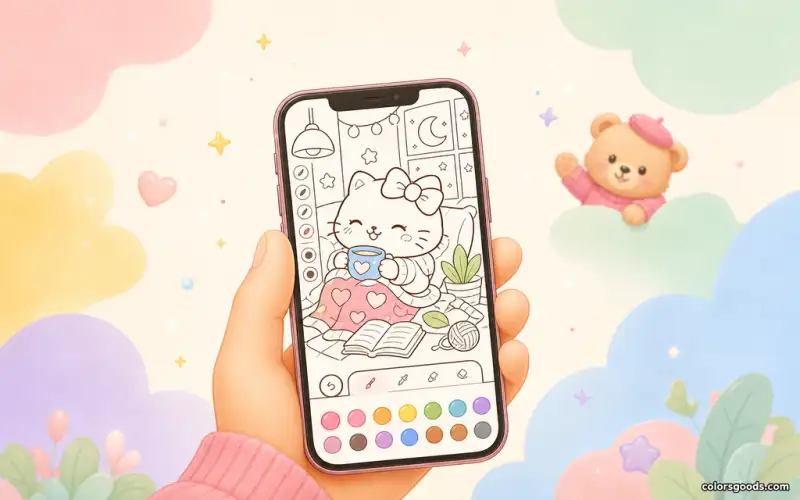
- Use digital tap-to-fill. For people with reduced fine motor skills, tapping to fill removes precision demands and keeps the experience positive.
Research on arts-based activities for people with dementia — including a Cochrane review of art therapy interventions — points to improvements in attention, communication, and mood after sessions. The honest framing: coloring supports comfort and engagement; it does not change the course of the condition.
A wellness routine that fits your life
Whatever your reason for coloring, the same framework works:
- Pick pages that match your energy. Simple pages on low-energy days; more detail when you want engagement.
- Limit your palette. Three to five colors reduces decision fatigue and keeps the session calming.
- Set a gentle timer. Ten to twenty minutes is a meaningful session without becoming an obligation.
- Make it easy to start. Keep a page open on your phone or a book on your desk.
- Notice, do not judge. Pay attention to how you feel before and after, and use that information to adjust.
For beginners choosing pages, our coloring pages for adults guide covers what makes a page work well for relaxation and mindfulness.
FAQ
Can coloring really help with ADHD focus?
Coloring does not treat ADHD, but it supports several functions that ADHD impairs — sustained attention, emotional regulation, and impulse control. Many adults with ADHD report that regular sessions reduce restlessness and help them focus on subsequent tasks. It works best as one tool among many, alongside professional care.
How is coloring used in burnout recovery?
As a low-pressure, low-effort practice that restores the capacity for rest and pleasure. Short sessions with simple pages, no completion requirement, and no performance standard.
Is coloring beneficial for seniors?
Yes. With pages designed for clarity — bold outlines, larger areas, low visual noise — coloring is accessible, enjoyable, and easy to share with family.
Does coloring help people with dementia?
Arts-based activities, including coloring, are associated with improved attention, reduced agitation, and better mood in dementia care. It engages preserved procedural memory and provides emotional comfort. It is a support for quality of life — not a treatment, and not a substitute for professional care.
Conclusion
Coloring for wellness is a single, simple practice that adapts to nearly any stage of life. For focus, for recovery, for older age, and for care — the same gentle activity supports attention, calm, connection, and a sense of accomplishment. Its greatest strength is accessibility: anyone can begin in the next five minutes.
If you want the deeper science, our coloring for mental health complete guide covers the evidence for anxiety and trauma. To build a daily stress routine, start with coloring for stress relief, and for the broader creative context, the art therapy complete guide shows how structured creativity supports wellbeing across the board.
Learn more about the project →
Colors Goods is researched, written, and reviewed by our small editorial team so every post stays clear, practical, and family-friendly.
Reviewed by Maya Chen
Editorial contributor — mindfulness and relaxation coloring