Color by Number Games: The Focus and Flow Benefits Explained
Color by number games are puzzles where every region of a picture is marked with a number, and each number maps to a specific color from a small palette. You pick the color that matches the number, fill the region, and move on until the image is complete. The format has existed in paper coloring books for decades, and it became one of the most popular categories of mobile coloring apps — think of names like Happy Color or Tangle — because it offers a clear goal, a tiny set of decisions, and a finished result that almost always looks good.
The benefit people notice first is focus. Because the picture tells you exactly what to do, color by number removes most of the creative decision-making that can feel overwhelming when you sit down to color freely. What remains is a simple loop — read a number, choose a color, fill a space — that is easy to enter and hard to interrupt. That loop is also what makes these games genuinely relaxing, and the same research that supports coloring for stress relief supports this structured version of it.
If you are comparing apps and want to understand the broader landscape before choosing, our best coloring apps of 2026 guide groups the whole market by category. This post focuses specifically on color by number: what it is, why it feels so good, and when free coloring is the better choice.
What Is a Color by Number Game?
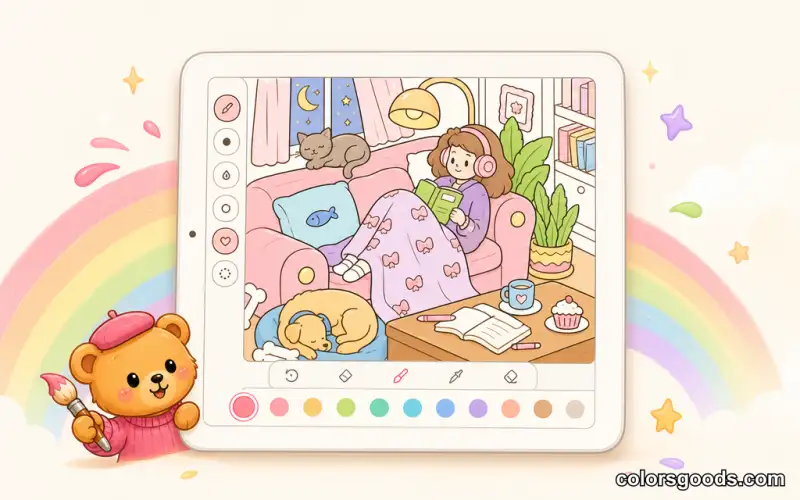
A color by number game gives you a line drawing where each closed region carries a number. The palette is fixed: color 1 is cream, color 2 is warm brown, color 3 is terracotta, and so on. Your job is simply to apply the right color to the right number, one region at a time.
Most digital versions add a convenience that paper books cannot offer: tapping a numbered region fills it instantly with the correct color. This is why the format works so well on a phone — there is no precise drawing required, no bleeding outside the lines, and no frustration when your hand slips. Apps like Happy Color and Tangle popularized this tap-to-fill style, and their success shows how much people value a coloring experience with zero skill barrier.
Two variants exist. In guided play, the app fills regions as you tap, which is the most relaxing mode. In challenge mode, you count how many regions of each color are left, which adds a light puzzle element. Both share the same core promise: the picture decides the colors, so you never have to.
The Benefits of Color by Number Games
The main benefits of color by number games are easy entry, a gentle sense of progress, and a reliable path into a focused, flow-like state.
Psychologist Mihaly Csikszentmihalyi described flow as complete absorption in an activity that has clear goals, immediate feedback, and a balance between challenge and skill. Color by number delivers all three by design. The goal is visible (finish the picture), the feedback is instant (every region changes color as you fill it), and the challenge is low but real. For a practical explanation of why that combination feels so satisfying, the PositivePsychology guide to Csikszentmihalyi and the flow state is a great starting point.
There is also a measurable relaxation angle. Time magazine covered the adult coloring boom and the science behind it, and the Mayo Clinic Health System has written about coloring as a surprisingly serious form of self-care. Structured activities that combine repetition with light mental engagement are consistently linked to lower momentary stress. What color by number adds is structure: the fewer decisions you have to make, the faster you slip into the rhythm.
- Focus. One decision at a time, guided by numbers, means your attention stays on the picture instead of on "what should I do next?"
- Flow. Clear goal, instant feedback, low stakes — the three ingredients of an absorbing, time-flying session.
- Low pressure. Mistakes are near impossible, so there is nothing to feel anxious about.
- Quick wins. Even a five-minute break produces visible progress on the page.
Color by Number vs Free Coloring
Free coloring gives you full control: you choose every color, decide the palette, and take responsibility for how the finished page looks. It is a genuinely creative act, and for many people that freedom is the entire point. Our guide to coloring for stress relief explains why this freeform version is so effective as a daily reset.
Color by number trades that creative freedom for guidance. You give up the choice of colors, and in return you get a guarantee: the result will be harmonious, because the palette was designed by the page itself. That trade-off is ideal when you are tired, overwhelmed, or simply want the meditative part of coloring without the decision-making part.
They also differ in mental load. Free coloring demands more from your attention — which is excellent when you want active engagement. Color by number is lighter; it suits moments when your brain is already full and you just want to follow a pleasant, numbered path. Many people alternate between both depending on the day, and a good app offers you both modes.
For Adults and Children
For adults, color by number is one of the most accessible mindfulness tools available. It requires no artistic skill, no supplies, and no setup, and it produces a satisfying finished image every time. It is especially popular with people who find open-ended coloring stressful or who want a screen activity that does not demand reaction speed.
For children, the numbered format adds a subtle educational layer. Matching a number to a color reinforces number recognition, following instructions, and patience. It also teaches kids to see a picture as a set of parts that fit together — a genuinely useful visual skill.
One honest note: digital color by number is still screen time, and for young children balance matters. The World Health Organization recommends more active play and less sitting for healthy development, so treat a session as a calm, shared activity rather than a long solo habit. A paper color by number book is a great alternative for travel or wind-down time.
FAQ
Are color by number games good for stress relief?
Yes. Structured coloring has been linked to lower momentary stress and anxiety in studies since the mid-2000s, and color by number adds even more structure by removing color decisions. It is a complement to stress management, not a treatment.
Do color by number games improve focus?
They train sustained attention: the numbered loop keeps you returning to one simple task, which is exactly the pattern that builds concentration over repeated sessions.
Are color by number games for adults?
Absolutely. Adult color by number apps are one of the most popular coloring categories, valued for low-pressure relaxation rather than for kids.
Are color by number games good for children?
Yes, in moderation. They reinforce numbers, following instructions, and fine-motor control, and they are a calm alternative to fast-paced games.
Is color by number better than free coloring?
Neither is better — they serve different moods. Color by number suits low-energy, low-decision moments; free coloring suits times when you want creative control and self-expression.
Conclusion
Color by number games earn their popularity for a simple reason: they make the benefits of coloring — focus, flow, relaxation, quick satisfaction — reliably available to anyone, regardless of skill. When you are tired and want to follow a numbered path instead of making decisions, they are hard to beat. When you want to create freely, freeform coloring is waiting.
Try both sides of the spectrum: start a free coloring page today on ColorsGoods, where everything runs in the browser without download or sign-up. And if you want to understand which app style fits your routine, read our best coloring apps of 2026 comparison.
Learn more about the project →
Colors Goods is researched, written, and reviewed by our small editorial team so every post stays clear, practical, and family-friendly.
Reviewed by Daniel Costa
Editorial contributor — app features and digital tools