Digital Detox with Coloring: Replace Passive Scrolling with Active Painting
A digital detox does not have to mean deleting your apps or throwing your phone in a drawer. The most sustainable version is much smaller: redirect the same break-time minutes you already spend scrolling into an active, focused activity like coloring. You are not subtracting screen time from your day; you are upgrading it. Passive scrolling feeds you an endless stream that never asks for anything back. Coloring gives you a closed page with a clear start, a visible finish, and a small, satisfying result at the end — often in less time than one scroll session.
This guide explains the difference between passive and active screen time, introduces a simple ten-minute rule, and shows how to swap scrolling for coloring without guilt or extreme rules. It is a practical approach, not a digital minimalism manifesto.
If you want the science behind why this works, our coloring for stress relief guide covers the relaxation side in depth. And when you want to make the habit part of a real routine, coloring lifestyle integration shows how to weave it into daily life.
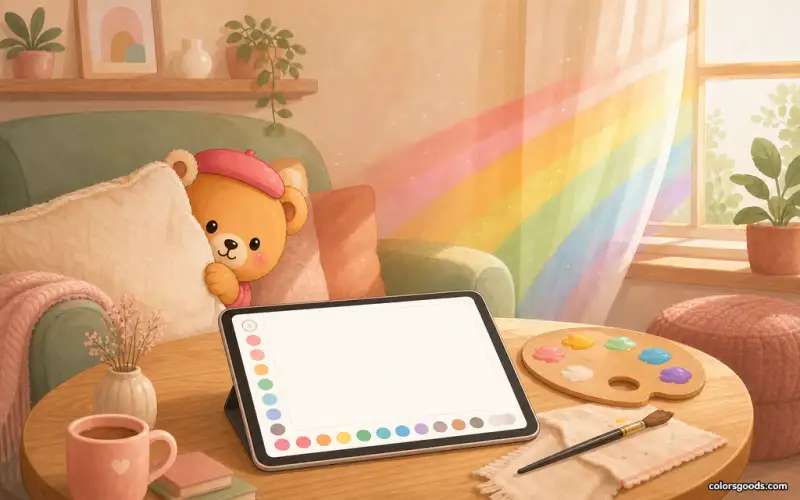
Passive scrolling vs active painting
The two activities feel similar — both happen on a screen, both can absorb ten minutes — but they are opposites in how they treat your attention.
Passive scrolling hands the control to the feed. The algorithm decides what you see next, each post pulls for another swipe, and the session usually ends because you reached a stop point you did not choose. Health experts at Cleveland Clinic specifically suggest taking breaks from your phone and replacing passive time with hands-on activities like puzzles or projects — exactly the kind of swap this guide describes.
Active painting (or coloring) puts you in control. You choose the page, the palette, and the pace. Every stroke produces a visible result that you created. The session ends when you decide it does — because the page is done, or because ten minutes is up, or simply because you feel like stopping.
The practical difference shows up in how you feel afterward. Scrolling tends to leave a vague sense of having consumed something without producing anything. Coloring leaves something you made, even if it is just a small section of a cozy scene. Healthline's overview of stress highlights how engaging, restful activities help manage daily stress levels — and coloring qualifies as one of the simplest available.
The ten-minute rule
The ten-minute rule is embarrassingly simple: for the first ten minutes of any scroll session, color instead. Not instead of forever — just for the first ten minutes.
Here is how it works in practice:
- Choose your trigger. Pick one recurring scroll moment: the morning scroll in bed, the lunch-break scroll, the evening couch scroll. One is enough to start.
- Make coloring the default. Keep a page open on your phone or a small book next to the couch, so starting takes zero effort.
- Set a soft timer. Ten minutes of coloring. When the timer goes off, you can keep coloring, put it down, or scroll freely — no rules broken either way.
- Notice the difference. Pay attention to how you feel after ten minutes of coloring versus ten minutes of scrolling. The contrast is usually enough to make the swap stick on its own.
Why ten minutes? Because it is long enough to get absorbed — to choose colors, fill a few shapes, find a rhythm — and short enough that it never feels like a chore. A complete session, not a quota.
Replacing habits without guilt
The fastest way to fail a digital detox is to treat it as a ban. Bans create guilt, and guilt turns a gentle habit into a performance you can fail at. A replacement works better:
- Swap, do not ban. You are not "quitting" scrolling. You are choosing coloring for the first ten minutes. The feed still exists.
- Drop the all-or-nothing thinking. Missed a day? Fine. Scrolled for an hour and forgot? Fine. The rule resets at the next scroll session — there is always a next time.
- Keep the stakes low. The goal is a slightly better ten minutes, not a digital transformation. Small swaps repeated often are what change habits.
- Track what feels good, not what you avoided. Notice the sessions that felt calmer. That feedback, not willpower, is what makes the habit last.
If you want to build on this without turning it into a rigid schedule, our coloring lifestyle integration guide covers routines, travel, and sharing — all the ways coloring fits into a real life instead of a perfect plan.
FAQ
Do I have to delete my social media apps?
No. This approach is about swapping the first ten minutes of a scroll session, not removing apps or accounts. Deleting apps works for some people, but it is not required — and a gentler swap usually survives longer than a dramatic purge.
How long should I color instead of scrolling?
Ten to fifteen minutes is ideal. Long enough to get absorbed, short enough to fit into the same break you would have spent scrolling.
Does coloring on a screen count as screen time?
It is screen time, but it is active screen time: you are making choices and producing something instead of consuming passively. If your goal is a completely screen-free break, color on paper instead — the same swap works offline.
What if I keep forgetting to color?
Attach the swap to a trigger you already have. Leave a page open on your phone or a book next to the couch, right where your thumb lands. When the habit depends on your environment instead of your memory, it stops needing willpower.
What if I scroll anyway and feel guilty?
Let it go. Guilt is the enemy of gentle habits. The ten-minute rule resets at the next session — nothing is lost, nothing to make up for. Just start again next time.
Conclusion
A digital detox does not have to be dramatic. The sustainable version is a quiet swap: the first ten minutes of a scroll session become ten minutes of coloring — active, focused, and yours. No bans, no guilt, no perfect streaks. Just a small choice repeated often.
Start today with one trigger moment and one page. For the relaxation science behind the habit, read our coloring for stress relief guide, and when you are ready to make it part of your routine, coloring lifestyle integration is the natural next step. To begin, visit colorsgoods.com — free coloring in your browser, ready whenever your thumb reaches for a scroll.
Learn more about the project →
Colors Goods is researched, written, and reviewed by our small editorial team so every post stays clear, practical, and family-friendly.
Reviewed by Daniel Costa
Editorial contributor — app features and digital tools