Coloring Online on Your Computer: A Full-Screen Coloring Setup
Coloring online on your computer is exactly what it sounds like: opening a coloring tool in a desktop browser and filling in pages with your mouse, trackpad, or touchscreen — no app, no download, no sign-up. It is the same activity you would do on a phone, but on a big screen with the whole page visible at once. For many people, that difference alone makes desktop coloring calmer and more comfortable than they expect.
Most coloring websites are designed mobile-first, but that does not mean they work poorly on a computer. The opposite is true: large open shapes, zoom controls, and a full-screen view make desktop coloring a genuinely pleasant experience. This guide covers how desktop coloring compares with mobile, how the mouse and trackpad change the feel of a session, and which browser adjustments and scene types get the best results on a large screen.
For the full comparison of browser-based coloring options, our best online coloring websites guide is the place to start. If you want the mobile side of the story, see our coloring online on your phone guide. Here we focus on the desktop experience.
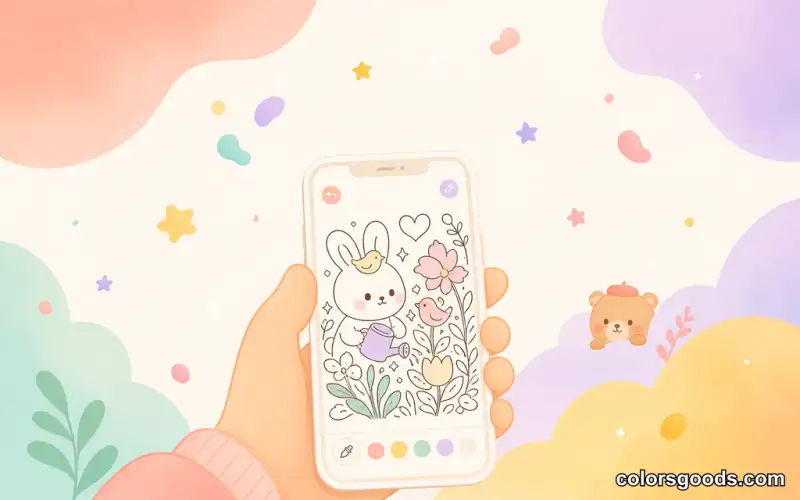
Phone vs Computer: What Actually Changes
The core coloring loop is identical on both devices: pick a page, choose colors, fill shapes. What changes is the ergonomics.
On a phone, the experience is compact and portable. You hold the device, tap regions with your thumb, and zoom with a pinch. It is perfect for short sessions — a commute, a break, a wait in line. The trade-off is screen size: small regions are hard to see, and you constantly zoom in and out.
On a computer, the whole page fits on screen. You see the full composition at a glance, which changes how you choose colors and where you start. Big regions become even easier to fill, and detailed areas are much more visible without zooming. The experience feels less like a quick task and more like sitting down to work on a page — which is exactly what many people want after work.
The practical difference: phones win for short, anywhere sessions; computers win for longer, more immersive sessions where you want the full picture in view.
Mouse and Trackpad vs Touch
The biggest surprise for new desktop colorists is how different the cursor feels from a finger.
Mouse. The mouse is the most precise option. You can hover over a tiny region and click with complete accuracy, and the steady cursor makes filling a long series of small shapes satisfyingly easy. If you spend a lot of time on detailed pages, a mouse is your friend.
Trackpad. A trackpad works well but asks for a little more care. Small regions need a steady hand and a precise tap, and scrolling while holding the cursor steady can take a moment to get used to. Most people adapt within a session or two.
Touchscreen. If your computer has a touchscreen, you get the best of both worlds: big-screen clarity with direct finger control. Many coloring tools support touch on desktop browsers, so tap-to-fill works exactly as it does on a phone, just larger.
One tip applies across all three: zoom in before tackling small regions. On a big screen it is tempting to stay zoomed out, but a quick zoom on a detailed area makes the cursor feel far more accurate and the session far more relaxing.
Browser Adjustments for a Better Coloring Session
You can improve the desktop coloring experience in a few minutes with simple browser settings:
- Go full-screen. Press F11 (or the full-screen button) to hide tabs and bookmarks. Fewer distractions, more page.
- Disable notifications. Before a relaxing session, silence notifications or put the browser in "Do Not Disturb" so nothing interrupts the flow.
- Zoom to your comfort. Use Ctrl + plus/minus to adjust the page size. If a coloring tool supports its own zoom, prefer that, since it keeps the layout intact.
- Close background tabs. If you are the type who keeps forty tabs open, a coloring session is the perfect excuse to close a few. The browser runs lighter and the focus is sharper.
- Use a dark or neutral theme. If the tool or the browser offers one, a dark interface around a colorful page reduces eye strain during longer sessions.
None of these are required — a browser opens and you color. But each one removes a small distraction, and removed distractions are the whole point of coloring online.
Ideal Scenes for a Large Screen
Some coloring pages simply look better and play better on a big display. If you are on a desktop, these scene types are worth prioritizing:
- Detailed scenes. Mandala-style pages, intricate interiors, and busy market or garden scenes have small regions that are hard to see on a phone but a pleasure on a monitor. Your mouse precision finally gets to shine.
- Landscape and wide compositions. Outdoor scenes, streetscapes, and wide interiors benefit from seeing the whole scene at once, which helps you plan a palette that works across the page.
- Full-page scenes. Any drawing designed to be seen as a whole — a cozy room, a café counter, a character in its environment — reads better when nothing is cropped.
- Cozy indoor scenes. Warm, detailed interiors feel like a natural fit for a big screen and a relaxed evening. If you enjoy these, our cozy coloring pages guide explains why they relax so reliably.
The general rule: if the scene is rich in detail or wide in composition, a computer is the better canvas. If it is large, simple, and quick, it works just as well on any device.
FAQ
Do I need to install software to color online on a computer?
No. Online coloring runs entirely in the browser. As long as you have a modern browser and an internet connection, you can start coloring immediately on any desktop or laptop.
Is coloring online better on a phone or a computer?
It depends on the session. Phones are better for short, portable, anywhere coloring. Computers are better for longer, immersive sessions where you want the whole page visible and mouse-level precision.
Is a mouse better than a trackpad for coloring?
For most people, yes. A mouse gives steady, precise clicks that make filling small regions easier. A trackpad works fine with a little practice, and a touchscreen gives you direct finger control on a large display.
Can I use my computer's touchscreen to color?
Yes, if the browser and the coloring tool support touch — most do. You get the visibility of a big screen with the directness of tapping with your finger.
What types of coloring pages are best for a desktop computer?
Detailed scenes, wide landscape compositions, and full-page drawings are the biggest winners on a large screen. Small, simple pages work everywhere but benefit less from the extra space.
Conclusion
Coloring online on your computer turns a pleasant mobile pastime into something closer to sitting down with a real page: the whole picture in view, a steady cursor, and the calm of a full-screen session. It costs nothing, installs nothing, and needs no account — just a browser and a few minutes.
Open a detailed scene, go full-screen, and let your mouse do the work. Start on ColorsGoods, where everything runs in the browser and pages are organized by mood so you can find the right scene in seconds. And if you want to see how desktop coloring fits into the wider world of online coloring, our best online coloring websites guide has the full comparison.
Learn more about the project →
Colors Goods is researched, written, and reviewed by our small editorial team so every post stays clear, practical, and family-friendly.
Reviewed by Daniel Costa
Editorial contributor — app features and digital tools